
Worship with us: Sundays at 10:30 a.m. (in person & online)
Heritage Congregational Church — Madison, WI
We gather every Sunday at 10:30 a.m. for Christ-centered worship, joyful music, and a warm community. Whether you’re joining us in person or online, you’ll find everything you need right here — livestream info, service times, directions, and ways to connect or request prayer.
Heritage Congregational Church is a freely gathered, Christ-centered community where faith, freedom, and fellowship guide our worship and service. Everyone is welcome to explore their spiritual journey, grow together, and serve Madison in love.
Join Us for Sunday Worship
Sunday Service:
10:30 a.m. – in person and online.
Join us in person:
Heritage Congregational Church
716 S. Whitney Way, Madison, WI 53711.
Madison’s west side. Free parking. Weekend bus service nearby.
See Location & Directions.
Online Livestream:
Join us on Zoom from home.
Email heritageoffice@heritagemadison.org for the weekly link.
Fellowship Hour:
Coffee and treats after worship – meet our pastors and church family.
Children:
Family-friendly service. Children are welcome in the sanctuary; quiet activities are available. Additional children’s programming is arranged as needed.
Accessibility:
Step-free entrance and wheelchair-accessible seating.
Upcoming Sermon Schedule
October 25, 2026 – “Ok, Whatcha Got?” – Pastor Synthia Taylor
Scripture readings: Psalm 90:1–6, 13–17 · Deuteronomy 34:1–12 · Matthew 22:34–46
Key Ideas: Religious leaders keep coming at Jesus with questions, hoping one will finally trip Him up. Instead, Jesus answers with startling clarity: love God with all your heart, soul, and mind, and love your neighbor as yourself. More than 2,000 years later, the command is still simple, demanding, and powerful. Come hear why Jesus’ answer still asks something real of us today.
October 18, 2026 – “For Example” – Pastor Mitch Taylor
Scripture readings: Psalm 99 · Exodus 33:12–23 · 1 Thessalonians 1:1–10 · Matthew 22:15–22
Key Ideas: Sometimes the clearest way to share our faith is simply to live it. Paul celebrates believers whose faith, love, and hope became an example to others, while Jesus calls us to recognize what belongs to God. Come reflect on evangelism through good living, and how everyday choices can quietly show others what faith looks like.
Music Director & Organist: Robert Eversman
Church Holy Day Worship Schedule
Plan ahead for these special services throughout the year:
- Ash Wednesday – Online-only via Zoom
- Good Friday – Worship at 11:00 a.m. with a free lunch to follow
- Easter Sunday – Worship at 10:30 a.m.
- Christmas Eve – Worship at 4:30 p.m.
- Christmas Day – No service unless it falls on a Sunday
Annual Church Events
Join us for these beloved annual gatherings that bring our community together:
- All Saints Sunday – Observed on the first Sunday in November
- Thanksgiving Potluck – Held the Sunday before Thanksgiving, immediately after worship


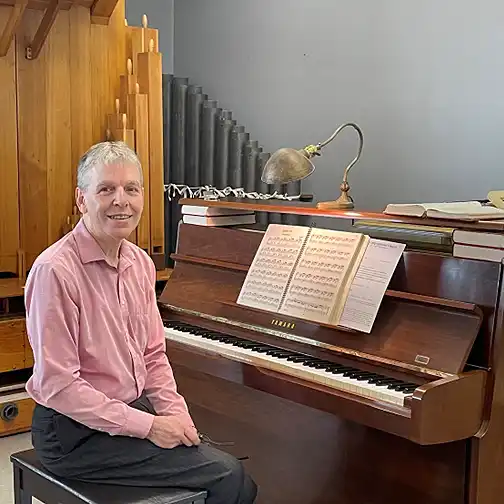

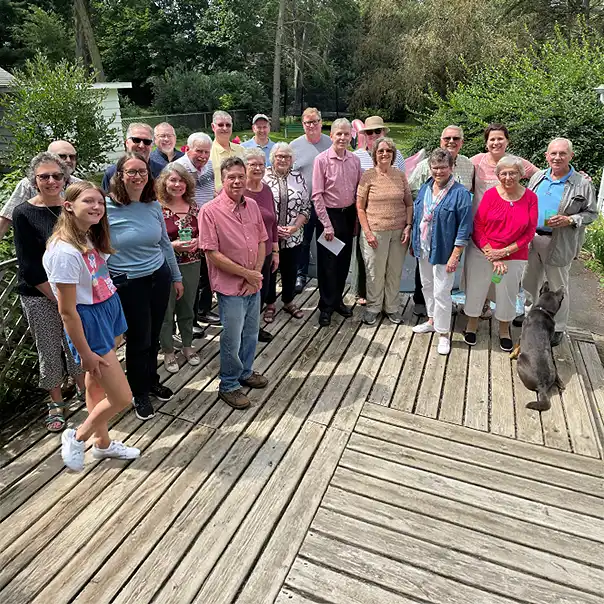


Snapshots of life at Heritage—family gatherings, service projects, worship in action, and our new Whitney Way center.
Prayers & Support
Prayer is one of the ways we care for one another at Heritage. If you are going through something hard, you do not have to carry it alone.
You Are Not Alone
At Heritage Congregational Church in Madison, we believe prayer is one of the simplest and strongest ways to receive support.
If you are carrying worry, grief, stress, illness, relationship pain, or a hard decision, you are welcome here.
Our church family cares about practical needs and spiritual needs. When you share a prayer request, you are inviting a circle of care: people who will pray, listen, and respond with compassion. If you are looking for prayer support in Madison, pastoral care, or simply a safe place to be heard, we would be honored to walk with you.
Submit a Prayer Request
If you would like prayer, you can email us anytime at:
This inbox is read by both our pastors and our prayer team. If your request is private, just say so in your message and we will treat it with care and discretion.
In your email, you can include your name (optional) and a few sentences about what you would like prayer for. If you would like someone to follow up with you, please mention that as well and include the best way to reach you.
Who We Are
The Heritage Congregational Church is a freely gathered community centered on Christ, bound together by covenant, and committed to faith, freedom, and fellowship. Scroll to discover our mission, our story, the people who lead us, and how to connect today.
In service to our Lord,
- We offer inspiring worship—vibrant music, thoughtful preaching, and open communion.
- We cultivate Spirit-led learning for people of all ages.
- We affirm and champion freedom of conscience for every person.
What does “Congregational” mean?
What does "Congregational" mean at Heritage?
What does “Congregational” mean?
Heritage is a Congregational Christian church. In the Congregational tradition, the local church community makes decisions prayerfully and together. Heritage is not controlled by a distant bishop, headquarters, or outside authority. The congregation itself helps guide the life of the church, including its ministries, leadership, and direction.
That does not mean “anything goes,” and it does not mean one person controls the church. Congregationalism is rooted in Christian faith, Scripture, worship, prayer, service, and community. It values both personal faith and shared responsibility, guided by our voluntary adherence to the Heritage Covenant.
In everyday life, this means we worship together, make decisions together, care for one another, and try to follow Christ together.
“I’m not even sure what I believe…”
You do not need to have everything figured out before you visit. People come to Heritage from many backgrounds: lifelong Christians, people raised Lutheran, Catholic, Methodist, Baptist, or in other traditions, people returning to church after many years, people who are not baptized, and people who are simply curious.
Visitors from other faith backgrounds, or from no religious background, are welcome to attend, listen, ask questions, and take their time.
Will I be pressured?
No. Heritage is not a cult, a private club, or a high-pressure religious group. You are welcome to visit, ask questions, and take your time. Giving is always voluntary, and belonging means a mutual commitment to be the church together, in accordance with the Heritage Covenant.
Our Covenant
We enter into this Covenant with God and with one another, believing that our faith in God is relevant to each day as it comes and affirming our desire to live and grow in fellowship as followers of Jesus Christ.
We believe in God the Father, our Creator; in Jesus Christ, His Son, our risen Lord and Savior; and in the Holy Spirit, alive and at work in the world today. We seek to know the will of God as taught in the Holy Scriptures and revealed to us in prayer. We recognize each person’s freedom to interpret the Scriptures according to individual conscience. We strive to walk in the ways of Jesus Christ as we know them now or may come to know them.
We believe the mission of this Church is to lead people to commit their lives to Christ, to witness and minister to the world through involvement in the concerns of contemporary society, and to work to achieve social justice, equality and community.
We welcome to our Fellowship all who wish to worship and work with us. We pledge to participate in the life of this Church, to give generously of ourselves and of our substance, to sustain one another in time of trouble, and to worship together.
The sections above explain how Heritage understands Congregational faith, who is welcome here, what to expect when you visit, and the covenant that guides us as a church community.
What We Teach at Heritage
At Heritage Congregational Church, we believe faith is not only something you think about — it’s something you practice. Our teaching is Jesus-centered, rooted in Scripture, and aimed at forming lives marked by prayer, endurance, compassion, and peace.
Whether you are new to church, returning after a long time, or simply curious, you are welcome here. We don’t assume you have everything figured out. We do believe God meets people honestly — in questions, in hardship, in growth, and in joy — and that the Christian life is a journey of becoming.
Teachings That Shape Our Journey
2026 - Recognizing Christ
Christ may come to us through call, draw, and recognition
Several early 2026 teachings returned to a simple but searching question: when God is moving, will we recognize Him? Some people seem to hear a clear call, like the shepherds or the disciples who left their nets. Others are drawn more slowly, like the wise men who followed a star. Either way, the invitation is not only to notice Christ, but to respond to Him.
That response often begins in ordinary life. Jesus finds people at work, at home, on familiar roads, and in moments when they may not have been expecting anything holy. Recognition is not always dramatic. Sometimes it is the quiet realization that God is asking us to change our mind, turn toward Him, and follow.
God is present in both the obvious and the slow
The teachings also reminded us that the power of God is not always seen in the same way. Sometimes it is visible and immediate, like the Transfiguration, a sudden moment when the disciples see Christ’s glory. Other times, God’s work is more like a canyon being formed one grain at a time: slow, patient, and easy to miss until we look back and see what God has been doing all along.
This is why Scripture, prayer, worship, and community matter. They train our eyes and hearts to recognize God’s presence. We do not interpret faith alone or only for ourselves. We listen together, pray together, and help one another stay close to the truth of what God is showing us.
The question is not only whether Christ appears, but whether we follow
A recurring invitation in these teachings was to move from recognition into discipleship. If Christ shows up in our work, our family, our conversations, our church, or our changing world, do we know Him when we see Him? And when we do, are we willing to follow?
2026 - Lent: Returning to God
Lent invites honest return
The Lenten teachings brought us into the work of returning to God: not with performance, but with honesty. Repentance was presented as more than saying, ‘I’m sorry.’ It is a change of mind, a turning away from what no longer gives life, and a turning back toward the kingdom of God that has come near in Jesus Christ.
In the story of Nicodemus, rebirth becomes a way of talking about home. We begin in one place, but in Christ we are invited into a new family, a new kingdom, and a new life. Lent gives us space to ask what has separated us from God, and what kind of life becomes possible when we are born of water and Spirit.
Christ teaches us how to face temptation
The temptations of Jesus were used as a pattern for understanding sin and freedom. The teaching named three familiar struggles: what we feed in the flesh, what we consume with our eyes, and what we worship in pride. These are not only ancient problems. They are daily spiritual realities.
The good news is that Jesus does not only expose temptation; He shows us how to answer it. When we are tired, hungry, discouraged, or worn down, Christ’s example teaches us to return to God’s Word, remember whom we serve, and refuse what keeps us bound.
Questions can become part of faith
Lent also made room for our questions. Scripture is full of people asking God, ‘Where are you?’ ‘How can this be?’ ‘Is the Lord among us or not?’ Heritage’s teaching did not treat those questions as failure. Honest questions can reveal a living relationship with God. They can become the place where God gives guidance, patience, correction, and grace.
The season also reminded us that the Spirit is not far away. In dry bones, in Lazarus, and in Paul’s words about life in the Spirit, the message was this: what needs life again may be closer to resurrection than we think. Christ does not only show us where we go when we die. He dwells in us and teaches us how to live.
2026 - Holy Week and Easter
Palm Sunday is not cancelled by the cross
Holy Week began with celebration. The teaching on Palm Sunday reminded us that the joy of Jesus entering Jerusalem should not be swallowed too quickly by the sorrow of Thursday and Friday. Yes, the week moves toward betrayal, suffering, and the cross. But Palm Sunday still matters. It is the day we remember that Christ is the long-awaited King who comes in humility.
The celebration of Christ is not shallow optimism. It is deeper than that. Holy Week holds anticipation, grief, sacrifice, and resurrection together. The sorrow is real, but it does not get the final word.
The resurrection meets us with fear and great joy
Easter brought us to the women at the tomb, where Scripture holds together two feelings that often do not seem to belong together: fear and great joy. The resurrection was not what they expected, even though Jesus had spoken of it. The stone was rolled away, Christ was alive, and the journey forward began with the command to go to Galilee.
That Galilee invitation became a pastoral word for our own burdens. When life is heavy, when we face fear, grief, health concerns, financial pressure, or uncertainty, the message was simple: go to Christ. Christ meets us on the road ahead.
Faith does not ignore facts; faith trusts Christ beyond them
In the story of Thomas, the teaching challenged a familiar phrase: faith over fear. Fear was not treated as the true opposite of faith. Instead, the message asked what happens when the facts of life challenge what we believe. Thomas had facts: Jesus had died, been buried, and then others claimed He was alive. Jesus met Thomas in those facts and offered peace.
The Emmaus road continued this Easter pattern. Jesus walked beside grieving disciples before they recognized Him. He opened Scripture, broke bread, and made Himself known. That becomes a model for how we share faith: walking with people, listening well, telling the story again, and letting our actions reveal Christ as much as our words.
2026 - Living the Faith Together
Faith becomes visible in words, meals, and kindness
After Easter, the teachings turned toward the everyday shape of Christian life. One message focused on the mouth: what we say, what we receive, and how we share life together. Words can breathe life or harm. Meals can become places of fellowship. The table God prepares is a place of abundance, but it also sends us out to speak love, hope, forgiveness, and good news.
Kindness was also lifted up as more than being nice. Niceness may be polite, but kindness acts. It notices the overlooked person, helps without needing attention, welcomes the stranger, and serves with humility. In a world that often treats kindness as weakness, the teaching named it as strength shaped by Christ.
We are living stones and stepping stones
The image of stones became a way to speak about spiritual growth. Christ is the cornerstone, and believers are living stones being built into a spiritual house. But stones also mark the path. Sometimes we are the ones following the next cairn. Sometimes God places us in someone else’s path as a stepping stone toward Christ.
This means growth is rarely instant. We move one step at a time, personally and as a congregation. We continue in prayer, worship, Scripture, mission, stewardship, and evangelism. We are not finished. The journey matters, and the call is to keep going.
The Spirit helps us live in the world without being ruled by it
Pentecost brought the reminder that the church lives by the Spirit in the world. This is a both-and life. We live in a physical world with real sorrow, pressure, injustice, and change, and we also live by the Spirit who gives peace, love, forgiveness, and gifts for the common good.
This life may look different than we expect. The Holy Spirit rarely arrives only to preserve our comfort. The Spirit equips the church to speak in ways people can hear, to make faith visible, and to serve the common good. In that sense, we are still learning to be salt and light: preserving what is good, illuminating what is true, and showing up together as a community of imperfect people practicing faith.
2026 - Faith for the Journey
Faith can begin again at any stage of the journey
Several teachings returned to the reminder that God is not finished with us because of our age, our circumstances, or what has already happened in our lives. Abram was seventy-five when God told him to go somewhere new. Others in Scripture came to Jesus when the situation already seemed impossible. Again and again, faith begins with trusting God enough to take the next step without knowing exactly where it will lead.
It is never too late to turn toward God, to follow a new calling, or to believe that something can still change. Faith does not require us to see the whole road ahead. It asks us to trust the One who does.
Hope begins with knowing whose we are and what we are worth
Christian belonging is not like membership in an exclusive club. Its privilege is rooted in God’s covenant, grace, and love. Scripture reminds us that God knows us, values us, and calls us His own. Jesus’ teaching about the sparrows became a reminder that if even they are known by God, our lives are known and valued even more deeply.
That worth does not promise a life without suffering. The teachings instead pointed toward a hope that can endure suffering: perseverance can form character, character can deepen hope, and hope can remain even when circumstances feel like a waterless pit. We were encouraged to become “prisoners of hope” through prayer, Scripture, service, community, and the confidence that God’s grace is larger than the situation immediately in front of us.
Faith grows through patience, practice, and honest questions
Spiritual growth takes time. Like preparing a wall before painting it or tending soil before expecting a harvest, faith asks for preparation and patience. We pray, read Scripture, worship, gather in community, and keep tending what God has planted even when we cannot yet see the fruit.
Growing faith also makes room for questions. The disciples themselves came to Jesus and said, in effect, “Explain this to us.” Not understanding is not the same as not believing. Sometimes mature faith means stepping away from the noise, admitting what we do not understand, and bringing the question honestly to God. We keep asking, seeking, and knocking, trusting that God meets us along the way.
2026 - Living Into the Kingdom
The kingdom of heaven is worth more than we expect
Jesus’ parables describe a kingdom that overturns ordinary expectations: treasure worth giving everything for, a pearl of extraordinary value, yeast working through the whole loaf, and a tiny mustard seed becoming something far larger than its beginnings suggest.
The teaching returned to the same truth in different ways: the kingdom of heaven is worth it. It is abundant, satisfying, and greater than what we can see at first. Following Christ may ask us to release things that hold us back, but what God offers is not smaller than what we leave behind. It is more than we expect.
We are called to receive what Christ gives
In the feeding of the multitude, a small amount of bread and fish became enough. In Communion, ordinary bread and a small cup become signs of something much larger. The teaching invited us not simply to observe what Christ is doing, but to be ready to receive what He gives.
We receive through worship, Scripture, prayer, the sacraments, mission, and one another. What looks small can carry far more than we first imagine. Communion reminds us that we belong to Christ and also to one another. Receiving from God therefore becomes more than a private experience; it draws us into community and prepares us to share what we have received.
God works through storms, small things, and transformed lives
Faith does not keep storms from coming. Peter discovered that Christ could meet him in the middle of one. When fear returned and Peter began to sink, Jesus reached for him, brought him back, and redirected his attention. The invitation is not to pretend that storms are harmless, but to remember who is present with us in them.
Other teachings reminded us that God’s work is often built from things that seem small: a little faith, daily nourishment, ordinary acts, and steps whose importance we may not recognize at the time. Over time, the scraps become a feast and individual acts become part of something much larger.
Paul’s call to be transformed by the renewing of our minds brings these themes together. Christian transformation is not simply positive thinking or changing ourselves to match the world around us. It is learning to see differently, to discern God’s will, and to allow our lives and our community to be reshaped from within. Faith for the journey eventually becomes a life that looks different because God has been at work in it.
Each topic above opens into a longer teaching summary.
2025 - Making Room for Christ
Christ is present and active among us
Christian faith begins with a simple claim: God is not distant. In Jesus Christ, God comes near — fully present, fully engaged with human life. We teach the incarnation not as a seasonal theme, but as an everyday truth: God’s presence changes what we expect, how we live, and how we treat one another.
We return often to the question: What does it mean to make room for Christ today — in a home, in a heart, in a community?
Scripture forms the way we live
We take the Bible seriously, and we approach it as something that forms people. Scripture is not a collection of inspirational quotes; it is the story of God’s relationship with the world, and it tells the truth about human nature, suffering, hope, and redemption.
In teaching, we aim to connect Scripture to real life:
- how it speaks into anxiety, loss, and confusion
- how it reframes identity and purpose
- how it calls us into repentance, forgiveness, and endurance
God grows character that bears fruit
A major theme in our teaching is transformation. Faith is not just private belief; it produces a life. In the language of Scripture, that life is “fruit”: integrity, patience, self-control, kindness, courage, generosity, and love.
We encourage people not to spend their energy only reacting to the brokenness of the world, but to ask a better question: What is God growing in me, right now — and what does faithful living look like today?
The goal is not moral superiority. The goal is Christlike maturity.
Each topic above opens into a longer teaching summary.
Meet the Team
Rev. Mitchell Taylor – Co-Pastor
Mitch is a gifted spiritual teacher committed to sharing the saving Gospel of Jesus Christ through love, community, and practical outreach. His preaching connects Scripture with everyday life and invites people to grow in faith together.
Dr. Synthia Taylor – Co-Pastor
Synthia is a coach, teacher, and master connector who leads others to faith by developing community and allowing God’s power to achieve Kingdom goals. Her ministry emphasizes relationships, encouragement, and helping people recognize how God is at work in everyday life.
Robert Eversman – Music Director & Organist
A Northwestern-trained musician and avid organ builder, Robert has guided Heritage’s music ministry since 2002 with creativity and joy. Through organ, violin, and thoughtful music leadership, he helps shape Heritage’s worship week after week.
Peter Brummel – Executive Assistant & Content Creator
With a background in education, technology, design, and communications, Peter brings a practical and creative mix of skills to Heritage. As Executive Assistant & Content Creator, he helps with the church’s day-to-day work, communications, and sharing Heritage’s life and faith with the wider community.


Rev. Mitchell Taylor, Dr. Synthia Taylor, Robert Eversman, and Peter Brummel are the day-to-day staff team supporting worship and the week-to-week life of Heritage.
Heritage is also carried by members and volunteers who share leadership and serve through worship, hospitality, education, and mission.
Music is part of how we worship and care for one another at Heritage. In this video, our Music Director and Organist, Robert Eversman, is featured on violin in a short music offering recorded during worship. We are grateful for the gifts shared in our congregation, and for the way music helps us pray, reflect, and rejoice together.
An Active Community
Heritage is supported by a wider team of members and volunteers who help the church run smoothly week to week. Behind the scenes, people serve in leadership and planning roles (board and committees), care for Sunday worship and music, support children and youth learning, and coordinate practical needs around the building and community life.
Shared leadership shows up in many ways at Heritage – from worship and hospitality on Sundays, to ongoing ministries in music, education, and local and global mission support. Heritage is an active community, with many people sharing the work and care of the church in different ways.
If you’d like to get involved, the easiest first step is to join us on Sunday and stay for coffee hour, or email the church office. If you’re just looking for a place to worship and connect, you’re welcome exactly as you are.
Our Story
In quest for freedom from a denominational hierarchy, Heritage Congregational Christian Church was born in 1968 with a storm, a rainbow, and a voluntary Church Covenant, freely adopted under the kind hospitality of a local Jewish synagogue.
After six decades of continual pilgrimage, we persist in the Congregational understanding that a church is an autonomous body of Christian believers, professing an open, lively faith—no matter what roof shelters our heads.
Heritage—A Church in Motion
1968 – Church gathered in crisis and calls Rev. Richard Pritchard as minister; first services held in a movie theater.
1971 – Moved to our first permanent meetinghouse on Segoe Road.
1991 – Moved to a new meetinghouse on Prairie Road, our home for three decades.
2023 – Moved, in the midst of covid, to a rented storefront at 716 S. Whitney Way, in the heart of Madison’s thriving West Side. This move shifts our attention from a physical property to a lively local worship, community outreach, and global mission.
Today – We worship in person, online, and everywhere God calls—affirming that our church is not a building but a family of faith.
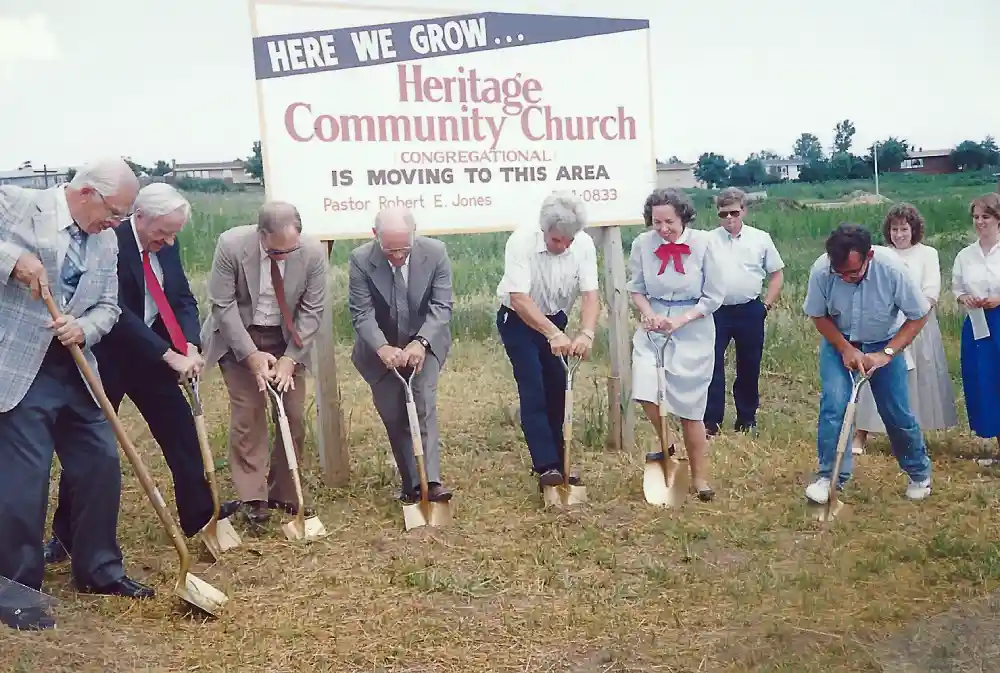
Here we grow … Heritage Community Church breaks ground on its new Prairie Road meetinghouse under Pastor Robert E. Jones in early 1990. The “Here We Grow…” sign heralds the church’s long-range plan—first drafted in 1983—to relocate to Madison’s southwest growth zone.
Frequently Asked Questions
How do I attend?
Just come as you are.
What should I wear?
Most people dress casually, but you’ll see everything from jeans to “Sunday best.”
How long is the service?
Sunday worship begins at 10:30 a.m. and ends around 11:30 a.m., followed by coffee-hour fellowship.
Can my children stay in the sanctuary?
Absolutely. Wiggles and whispers are welcome; quiet activities are available. Heritage Congregational Church is a family-friendly church in Madison.
Are youth or teen programs offered?
We pride ourselves on being a multi-age Christian learning space. We joyfully worship together and develop activities to meet the needs and talent of our youth and teens.
Are there accessibility accommodations?
Yes—step-free entry, accessible restrooms, wheelchair seating, and large-print bulletins.
Where do I park?
There are plenty of parking spaces immediately adjacent to our storefront meetinghouse.
Do you livestream services?
Yes—Please email heritageoffice@heritagemadison.org for online link.
How is communion served?
Open communion is celebrated on the first Sunday of each month; all who seek to follow Christ are welcome.
How do I meet the pastors?
Rev. Mitch and Dr. Synthia greet visitors after worship or by appointment—email heritageoffice@
Is giving expected from visitors?
We place no expectations on those who walk through our doors. Monetary gifts are welcome, but like all activities in our church, voluntary. If you wish to donate, the collection plate is on a stand to the side of our worship space; we do not pass the plate during the service.
How do I become a member?
Membership in a Congregational church is a matter of joining mutually with the other members in our specific Church Covenant. This is called “owning the Covenant.” Our covenant is posted in our worship space. You will meet with our pastors, attend one or more classes, and be welcomed during worship. Email one of our Pastors or contact Heritage Office, heritageoffice@heritagemadison.org, for further details.
Does this church conduct baptisms, weddings, and funerals?
Yes. If you need these Pastoral services, please email our office heritageoffice@heritagemadison.org.
Do you offer practical assistance like food in Madison?
Yes. Our church works through the Allied Partners Food Pantry (FindHelp.org listing). If you or a neighbor needs food, this pantry can help. For other help (rent, utilities, medical or mental health care, transportation, and more), search FindHelp.org. If you need assistance or guidance, email or call us, or speak with a pastor during Fellowship Hour after worship.
Reach Heritage Congregational Church at 716 S. Whitney Way by exiting US-12/18 onto Whitney Way north and driving 0.7 miles—our building will be on your left.
Location & Directions
Heritage Congregational Church
716 S. Whitney Way, Madison, WI 53711
Open in Google Maps
(Scroll down for the mailing address.)
Driving
- Drive from the Beltline (US 12/18): Exit Whitney Way north; we’re 0.7 mi on your left.
- Parking: Free lot on the south side; overflow next door at the medical clinic on Sundays.
Public Transportation (Madison Metro Bus)
- Service stops near S. Whitney Way & Odana Rd. — routes D, E, J (nearest stops: 2665, 2522, 2778).
- Trip planner (real-time): https://metromap.cityofmadison.com
- Routes & schedules: https://www.cityofmadison.com/metro/routes-schedules
- You can also plan your bus trip on Google Maps (pre-set to public-transit directions)
Contact Details
WHITNEY WAY CENTER
Heritage Congregational Church
716 S. Whitney Way
Madison, WI 53711
MAILING ADDRESS
Heritage Congregational Church
P.O. Box 46130
Madison, WI 53744


Office Hours:
Tuesday–Friday, 9 a.m.–1 p.m. (call ahead to confirm).
Office Phone: (608) 492-1294
Office email: heritageoffice@heritagemadison.org

Heritage Congregational Church
Street Address: 716 S. Whitney Way, Madison, WI 53711
Mailing Address: P.O. Box 46130, Madison, WI 53744
Office Hours: Tuesday–Friday, 9 a.m.–1 p.m.
Office Phone: (608) 492-1294
Office Email: heritageoffice@heritagemadison.org
Directions & Transit
Google Maps: 716 S. Whitney Way
From Beltline (Hwy 12/18): Exit Whitney Way north; church is 0.7 mi on the left.
Parking: Free lot; Sunday overflow next door.
Bus: Routes D, E, J; stops near S. Whitney Way & Odana Rd. (2665, 2522, 2778).
Connect With Us on Social Media
Facebook: facebook.com/heritagemadison
YouTube: youtube.com/@heritagemadison
Instagram: instagram.com/heritagemadisonwi
Share Your Experience
Leave a Google review to help others find us.
Food & Local Support on findhelp.org
Our hands-on outreach: Allied Partners Food Pantry
Legal / nonprofit name: Heritage Congregational Christian Church
Official domain: heritagemadison.org
EIN / Federal Tax ID: 39-1098054
Wisconsin Certificate of Exempt Status (CES) number: 008-0000150988-05
Organizational Information: https://heritagemadison.org/organizational-information/
Office Email: heritageoffice@heritagemadison.org